
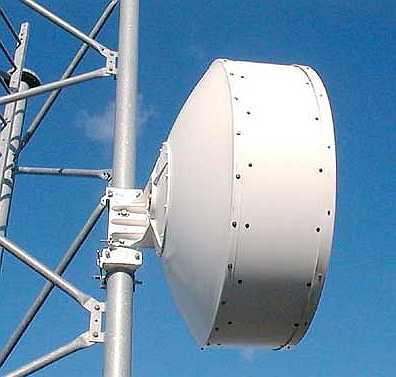
Both masts and towers are highly resistant to vertical loads. Customers often ask us whether a mast can support a specific amount of equipment (expressed in kilograms). The answer is almost always yes—because for the structural stability of mast structures, the total lateral surface area of the installed antennas is much more important than the weight. The mast acts like a sail, generating large uplift forces on the guy wires that hold it taut, causing it to tilt away from the vertical.
A key feature of a properly designed structure is that its deviation from the vertical does not exceed 1:100 of its height at the maximum wind speed characteristic of the wind zone in which the structure is installed. It follows from the above that the key information for us as manufacturers is the expected wind zone and the total lateral surface area of the planned antennas.
Once we know what types of antennas you plan to install on a mast or tower, and once we have the details of your property, we can recommend the appropriate series of structures. As a general rule, radio links require rigid structures (with minimal susceptibility to wind-induced deflection), while omnidirectional antennas have considerable tolerance in this regard (though they are sensitive to low separation). High rigidity usually results from the structure’s weight, which in turn affects the price. It is therefore worth considering whether—and to what extent—we actually need such high rigidity, so as not to overpay.
Another factor worth considering is the margin of strength required for future expansion of the antenna array. In the case of masts, increasing the load-bearing capacity is relatively simple—to a certain extent, it boils down to replacing the guy wires with thicker ones and reinforcing the anchoring elements. With towers, however, this is not an option. The weakest element is usually the segment near the ground, and any expansion—if no margin was built in from the start—means replacing it, which in turn requires dismantling the entire tower.