
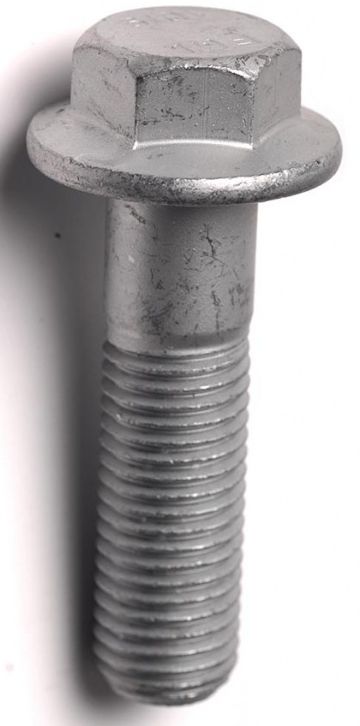
In the mast industry, flanged connections are practically the standard. The strength of the flanges—and thus of the entire structure—depends on the bolts that connect them. Everyone knows that bolts come in specific strength “grades.” How do these grades differ, and what exactly do we gain by choosing a higher one? Let’s take a closer look (based on the marmech.eu website).
The strength of a bolt is indicated by a two-digit symbol, such as 5.6, 8.8, 12.9, and so on.
How to read the markings on screw heads:
For example, class 5.6:
- the first digit isvalue of the tensile strength limit Rm- here5x 100 MPa = 500 MPa
- the second digit isvalue of the yield pointReexpressed as a percentage of the tensile strength Rm – here:6x 0.1 x 500 MPa = 300 MPa
In this example, the mechanical properties of the bolt are interpreted as follows: tensile strength Rm = 500 MPa and yield strength Re = 300 MPa.
The higher the numbers in the designation, the greater the bolt's strength.
What does it mean?
The yield strength (Re) is the stress value beyond which a bolt begins to deform plastically. In other words, if the load is less than this value, the bolt undergoes elastic deformation and returns to its original length once the load is removed.
The yield strength (Rm) is the stress that a bolt can withstand while undergoing plastic deformation until it breaks completely.
How much weight can a screw like this hold?
A more intuitive concept is “how much weight we can hang on such a bolt.” Remember that 1 MPa = 1 N/mm² = 0.1 kg/mm². A Class 5.6 bolt therefore has the following parameters: Rm = 500 MPa = 50 kg/mm² and Re = 300 MPa = 30 kg/mm². This means that we can suspend 30 kg per 1 mm² of cross-sectional area before the bolt begins to permanently elongate, and a maximum of 50 kg before it breaks completely.
For example: An M6 screw has a cross-sectional area of approximately 20 mm². On a Class 5.6 bolt, we can “safely” suspend 30 kg/mm² × 20 mm² = 600 kg, and a maximum of 50 kg/mm² × 20 mm² = 1000 kg, before it breaks.
A2 type stainless steels are marked with the following symbols:
- A2-70 – A2 stainless steel, Rm 700 MPa, Re 450 MPa;
On the other hand, Type A4 acid-resistant steels:
- A4-80 – A4 acid-resistant steel, RM 800 Mpa, Re 600 Mpa